
Drifter Star: Evolution — A Cosmic “Big Fish Eats Small Fish” Game Where the Real Fun Isn’t Eating—It’s Waiting

On December 10, 2025, an indie game called Drifter Star: Evolution launched quietly on Steam for around $3. Its core loop can be summed up in one sentence: you’re a meteor, eat the small ones, dodge the big ones, and keep eating until you become a black hole.
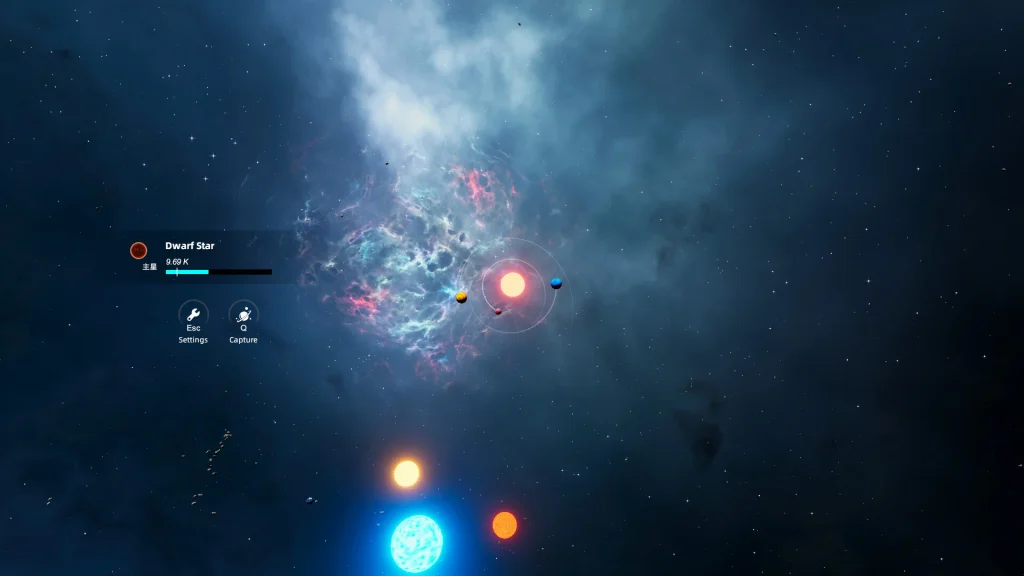
That “cosmic version of big fish eats small fish” premise sounds like a casual time-killer. But once you start playing, it turns out to be much more punishing than it looks—and that’s exactly what makes it fun.
From a Tiny Rock to a Black Hole, But What You Really Learn Is to Wait
Every run starts with a tiny meteor with a mass of 3. You start surrounded by celestial bodies larger than you, and your only option is to carefully devour the dust and debris smaller than yourself.
The game lays out a full evolution path: meteor → asteroid → dwarf planet → rocky planet → gas giant → dwarf star → star → giant star → supergiant → neutron star → black hole. Each evolution gives you a choice of three bonuses, each favoring a different playstyle—one might focus on defense, another on special attributes, another on attack power.
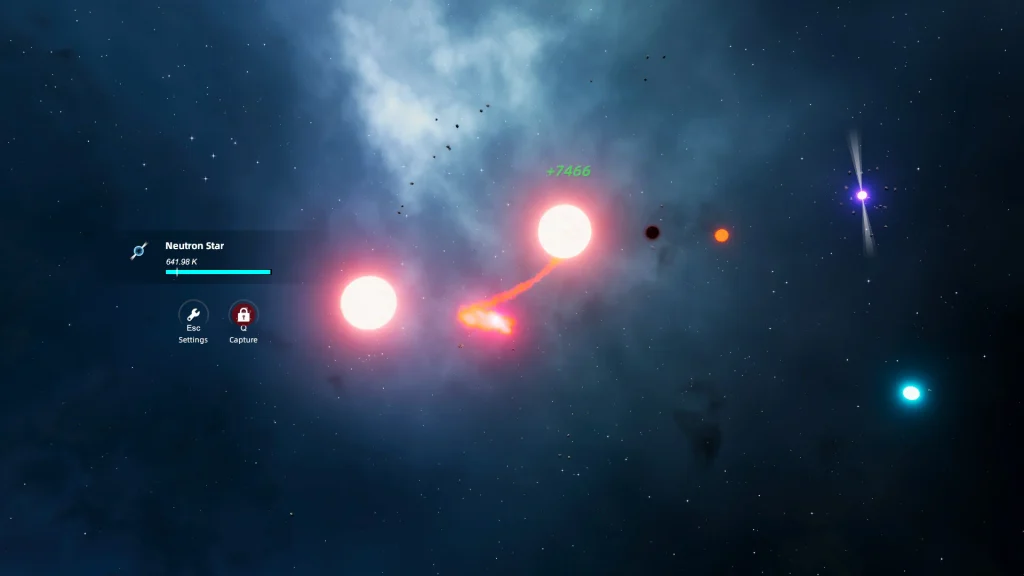
But what really sets Drifter Star: Evolution apart from ordinary “eat-to-grow” games is its gravity and collision mechanics.
Gravity isn’t just a visual effect here. Massive bodies pull in debris more strongly, while fast-moving bodies can fling away fragments they should have absorbed because of centrifugal force. You can even use gravity to “capture” smaller bodies and make them orbit you like moons.
A typical “eat-to-grow” game works like this: find something smaller → get close → eat it. Drifter Star: Evolution is more like: control your orbit → use gravity → wait for debris to drift into the right position → turn collisions to your advantage.
“Eating” shifts from a simple action into a spatial judgment. That’s where the real fun lies—not in “eating things,” but in learning to let the universe bring things to you.
One player shared a representative strategy: when other celestial bodies start colliding, keep your distance, slip into the chaos, use your ability to pull them in quickly, and collect the leftovers. That’s probably the most satisfying way to play—not attacking directly, but waiting for the universe to create opportunities on its own.
The Bigger You Get, the Bigger Things Start Hunting You
If you’re used to the straightforward eat-and-grow loop of other “big fish eats small fish” games, Drifter Star: Evolution will quickly teach you to slow down.
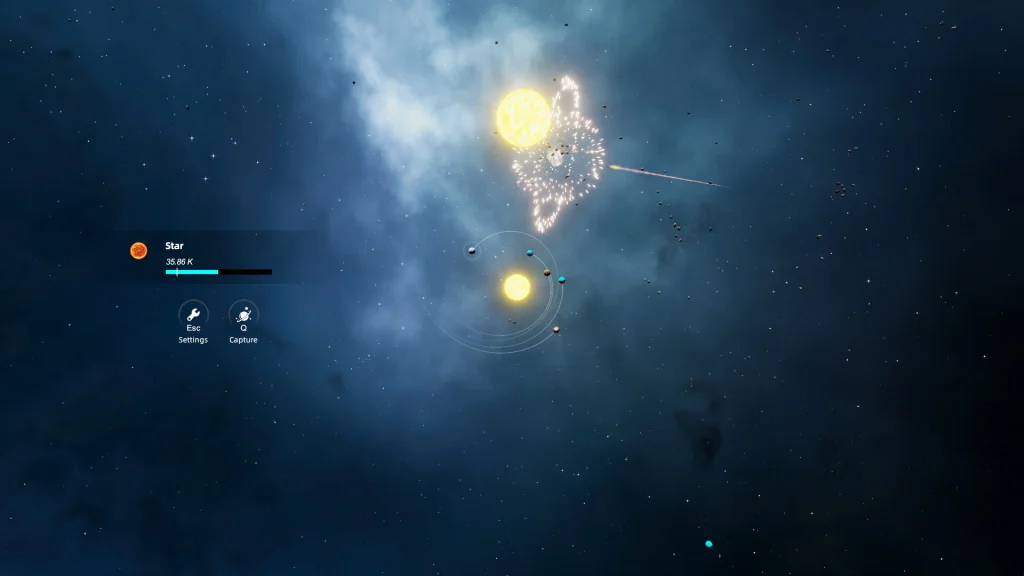
Colliding with something your own size is basically death, and hitting anything bigger kills you outright. You can’t try to punch above your weight—the game doesn’t give you that option. All you can do is pick off stragglers, circle around, and wait for the right moment.
But what’s even more tense is this: once you evolve into a larger form, higher-tier celestial bodies start chasing you.
That means evolution itself creates new threats. You go from “avoiding the big ones” to “being hunted by even bigger ones.” You eat small things → get bigger → gain new abilities → enter a new food chain → immediately become prey again.
That loop is the real core conflict of Drifter Star: Evolution. Growth isn’t purely a positive feedback loop—every upgrade not only gives you more devouring power, but also pushes you into a more dangerous position on the food chain.
Steam community discussions still include complaints about late-game large bodies relentlessly tracking the player, with some describing the second half as “one long escape sequence.” Either way, the result is clear: the game creates pressure—but whether that pressure becomes fun is something players disagree on.
The Universe Is Huge, But This Evolution Path Is Too Short
What makes Drifter Star: Evolution most striking is how it handles cosmic time scales.
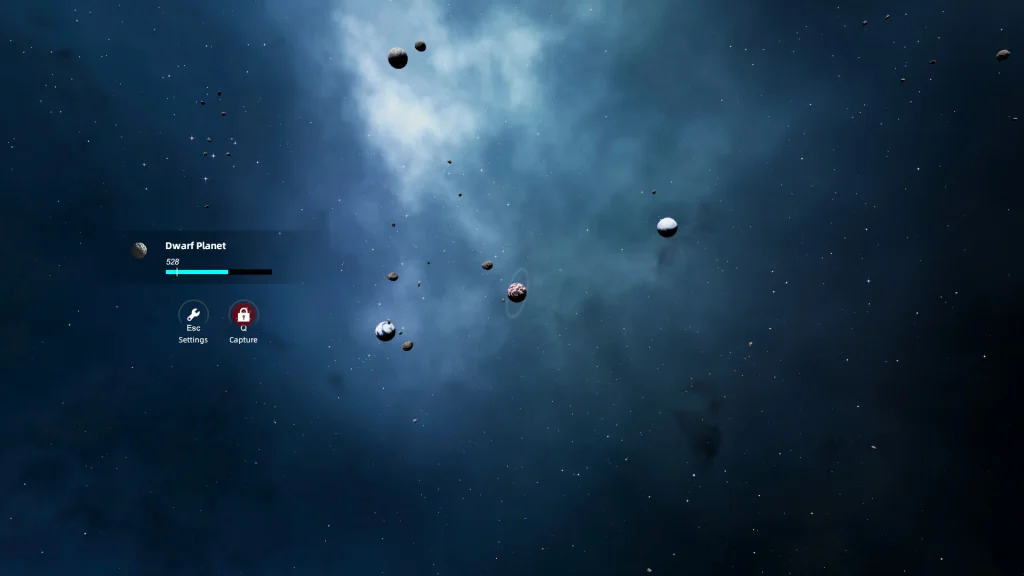
Real celestial evolution takes billions of years. The birth of a star, the formation of a black hole—on a human timescale, these are almost eternal. But in this game, an evolutionary process that should take billions of years happens in just a few dozen minutes.
From a mass-3 rock to a black hole that devours everything, you experience a cosmic timescale compressed into a matter of minutes. That sense of compression is a strange experience in itself.
But that’s also exactly where the problem lies.
The game makes the journey from tiny rock to black hole feel complete—so you see the entire evolution path very quickly. It’s not that there isn’t enough content; it’s that the growth fantasy is cashed in too fast.
Steam’s review distribution reflects this. As of this writing, the game has more than 1,100 Steam reviews and roughly 73% positive ratings overall. Recent reviews remain around 70% positive, so the game’s recent rating is still “Mostly Positive.”
Positive reviews focus on creativity and concept. One player wrote: “The game shows the birth of celestial bodies in the simplest way and with intuitive visuals—you experience an evolutionary journey that should take billions of years.” Others feel that there’s enough here for a $3 game.
The main criticism is straightforward: there’s not much reason to keep playing after you’ve seen the main progression. The game has only 5 Steam achievements and is very small in scope—for a game built around devouring and evolution, that’s a pretty small amount of content, and you can see most of what it has to offer very quickly.
On top of that, the mobile version also appears to have compatibility issues on some devices, so players planning to play on phones should check that their device can run it.
The Universe Is Big, But This Game Isn’t
You start as a mass-3 rock, learn to wait, circle around, and use gravity, and eventually become a black hole that devours everything. There is something genuinely romantic about that progression. But once you’ve actually eaten your way from meteor to black hole, you realize this compressed universe runs out surprisingly fast.
The real fun of Drifter Star: Evolution isn’t “eating things”—it’s learning to let the universe bring things to you. The catch is that this cosmic buffet ends too soon.
Copyright Notice: All game screenshots, character images, and related assets used in this article are the property of Kayla.Z, Mill Woo Studio, Happy Kayla, and their respective rights holders. This article is intended solely for informational, review, and commentary purposes.
Comments (0)
No comments yet