
Physician Simulator — You’re Not Learning to Heal, You’re Learning to Say “No”

On May 28, 2026, a demo for a game called Physician Simulator launched on Steam. The game is developed and published by Pavel Shishkin. Its Steam description is refreshingly blunt: a Papers, Please-style medical bureaucracy sim.
You’re not playing a doctor. You’re the gatekeeper.
You’re a Fresh Graduate Assigned to a Small-Town Clinic
The game is set in the fictional republic of “Zdravia.” After six years of medical school, you graduate and are assigned by the Ministry of Health to Clinic No. 67. Refusing the assignment means losing your degree.
Five patients walk through your door each day. Some just have a runny nose. Some show up with forged referrals trying to get opioids. Some are furious old women demanding the antibiotics they saw on TV. Most of them don’t actually need what they’re asking for.
Your job is to figure out who’s genuinely sick, who’s lying, and whether they should get a prescription, a referral, or be turned away.
You Have Four Tools, and One of Them Is Unreliable
Medical records. Allergies, chronic conditions, current medications. Skip a line, and you could prescribe something lethal.
Vital signs. Temperature, blood pressure, and a look at the throat. You need to cross-check what the patient says against what you measure.
Documents. Some referrals are legit. Some have forged stamps, expired dates, or the wrong license format.
The decision. Prescribe, refer, or reject. Every call you make affects your reputation.
You also have a reference book on your desk: lab values, drug interactions, symptom guides. And an AI medical assistant on your phone—it hallucinates 30% of the time. Use at your own risk.
That design is clever. It tells you with a joke: don’t trust any single source. You have to cross-verify everything yourself. And that’s exactly the core mechanic of a Papers, Please-style game—the system gives you tools, not answers.
It Doesn’t Simulate Medicine. It Simulates Incomplete Information.

If all the information were complete, this would just be a medical quiz. If every patient were honest, it would just be a diagnosis game. If every document were real, it would just be reading a chart.
What actually creates the gameplay is that different sources of information conflict with each other.
The patient says one thing. The chart says another. The vitals say something else. The documents might be fake. The AI assistant might be making things up. And then you have to decide.
That’s what makes Physician Simulator genuinely interesting. You’re not experiencing “healing”—you’re making decisions without ever having the full picture.
Five Days, Five Patients Each
The demo offers 5 in-game days, 5 patients per day, drawn from a larger patient pool. Steam’s official description says “every playthrough is different.”
That structure gives the demo some replay value—the same symptom can point to different causes, the same request can come from completely different motives. But it’s not yet enough to prove strong long-term replayability.
There’s also a scoring system—at the end of the week, you can be a star or a cautionary tale.
The full version is planned to include 5 weeks of work, a hidden “loyalty” track (which determines what tools you can access), recurring characters, branching story events, and 10 endings—from getting fired to graduating with honors.
What It Really Makes You Feel Is the Weight of Saying “No”
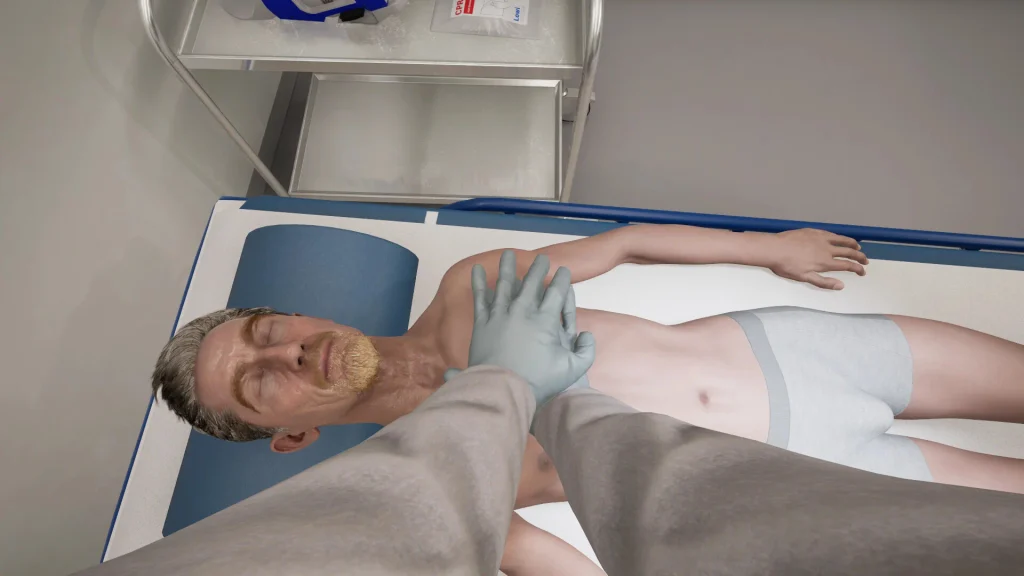
The game puts the moments where a doctor has to tell a patient “no” at the center of the experience.
You don’t need this drug. You can’t write this referral. Your situation doesn’t require the ER.
The pressure of that refusal doesn’t come from medical knowledge—it comes from interpersonal interaction. Patients get angry, they push back, they try to make you soften. And you have to make a judgment call with limited information and limited time.
That’s the essence of a Papers, Please-style game: the rules are simple, but enforcing them is hard. Because on the other end of the rule is a specific person.
Steam Reviews and AI Disclosure
As of this writing, the demo has 20 user reviews on Steam, all positive—but the sample size is still very limited.
The game’s interface supports 9 languages: English, Russian, German, Spanish, French, Portuguese, Czech, Japanese, and Simplified Chinese.
It’s worth noting that the Steam page explicitly discloses the use of generative AI: patient dialogue and feedback (with Russian as the source language) used AI assistance, and all in-game text localization (including Simplified Chinese) also used AI. The developer notes this openly on the Steam page.
The game asks you to verify everything because no single source is fully trustworthy. And that may be the most interesting thing about Physician Simulator: you’re never given a clean set of facts—only information you have to judge for yourself.
Copyright Notice: All game screenshots, character images, and related assets used in this article are the property of Pavel Shishkin and their respective rights holders. This article is intended solely for informational, review, and commentary purposes.
Comments (0)
No comments yet