
Unicorn Overlord Review: Vanillaware’s Tactical Masterpiece That Nearly Didn’t Happen

On March 8, 2024, Vanillaware joined forces with Atlus to release the tactical RPG Unicorn Overlord on Switch, PS4, PS5, and Xbox Series X|S. With its hand-drawn 2D art and a distinctive “programming” combat system, the game earned an 86 on Metacritic for PS5, 90 for Switch, and a 9 from IGN. It sold 500,000 copies worldwide in its first month and passed one million across all platforms by September 2024 — a sales pace notably faster than Vanillaware’s earlier titles like Dragon’s Crown and 13 Sentinels: Aegis Rim.
In an interview before launch, George Kamitani admitted the company had once again faced financial pressure during development. The project, whose earliest concept dated back to 2014 and spanned nearly a decade of work, was finally completed with support from multiple parties. As for what comes next, director Takafumi Noma told media there are currently no plans for DLC or a sequel; the intent is to let it stand as a complete standalone experience.

A game that almost never happened
Before diving into the gameplay, it’s worth understanding Vanillaware’s history. The studio, known for its pure hand-drawn 2D aesthetic, operates with under 30 people. Muramasa: The Demon Blade, Dragon’s Crown, and 13 Sentinels: Aegis Rim all came from this team. But hand-drawn art comes at a steep cost — over the years, the team has repeatedly found itself in severe financial straits. Kamitani once said the company was so strapped for cash that he had to use personal funds just to keep things running.
This context explains why Vanillaware is so restrained commercially. It isn’t a niche studio indifferent to money; it’s one that knows exactly how expensive this kind of work is, and has thus learned to push a project to its limits within the resources available — then bow out gracefully.
What story is it telling?
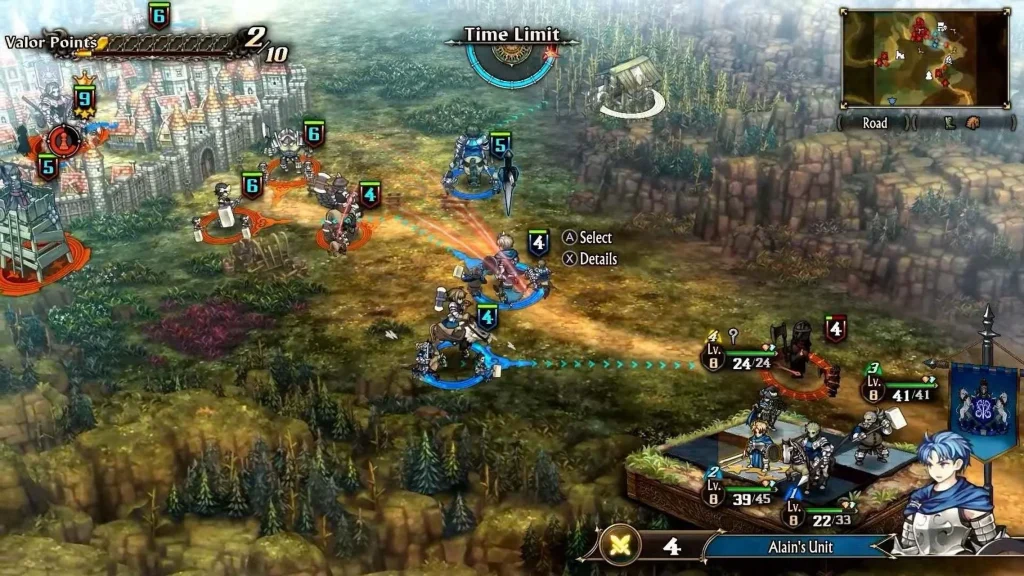
The continent of Fevrith is divided among five nations. General Valmore of the Kingdom of Cornia declares himself Emperor Galerius and launches an invasion against the entire continent. Queen Ilenia entrusts her young son, Prince Alain, to the knight Josef before riding off to face the enemy, only to be utterly defeated. Josef flees with Alain to the theocracy of Palevia. A decade later, wearing the legendary Ring of the Unicorn, Alain raises the banner of the Liberation Army to fight for the continent’s salvation.
Along the way, you liberate occupied towns and befriend a diverse cast of allies. Humans, elves, beastmen, angels — over 60 playable characters join your cause one by one. Liberate, recruit, rebuild, repeat.
Beneath this, however, lies a very Vanillaware touch of darkness: if you fail to rescue the heroine Scarlett in Chapter One, the story branches into an alternate outcome — she is captured, turned into an enemy pawn, and used against you. It’s not just a bad ending; it’s the game making failure devastatingly concrete.
Why is it fun? — “Two hours of programming, two minutes of fighting”
If you’re new to Unicorn Overlord, your first taste of combat might leave you bewildered. You can maneuver units across the overworld in real time, but the moment they engage the enemy, combat is entirely automatic. Who uses which skill, whom they target, when they heal — it’s all dictated by a set of pre-configured “Tactics” commands.
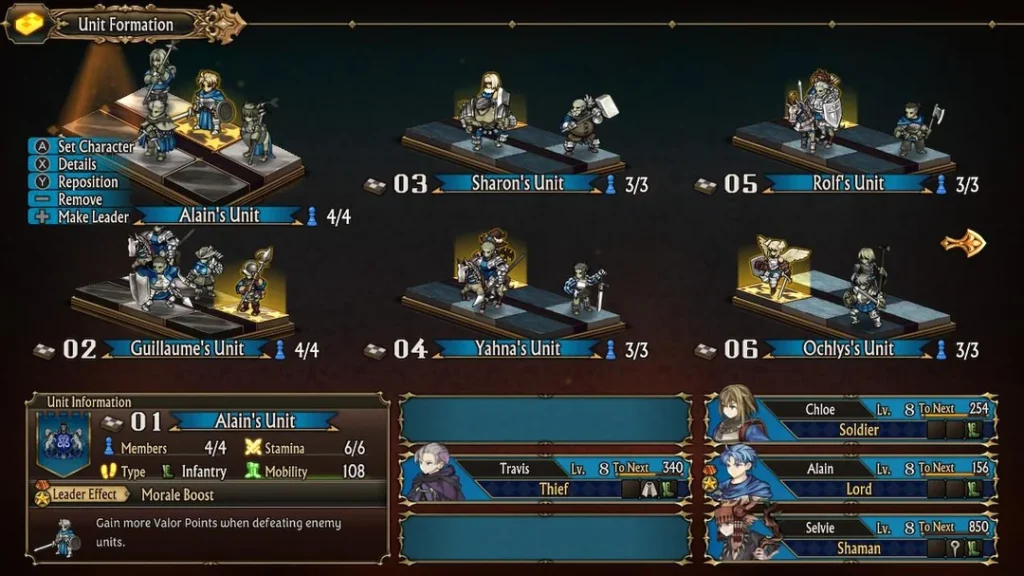
This is the core mechanic: tactical programming (akin to the Gambit system from Final Fantasy XII).
In the unit formation screen, each character occupies a slot in a 2×3 grid (frontline and backline), with up to five members per squad. You assign each skill a detailed triggering condition: prioritize certain enemy types, heal under specific circumstances, use particular passives against certain classes — the list of conditions reads like an introductory programming course.
The real joy is in discovering that the same team, with nothing changed but the order of their skill conditions, can produce wildly different battle outcomes. And the system shows you exactly what to expect: a prediction window previews the results before you confirm, so every tiny tweak gives instant feedback. When your anti-armor/anti-air unit also clears traps along the way and ends up soloing an entire map — that feeling of “I’m a tactical genius” is something few other games can deliver.
For those who don’t want to rack their brains, mature team compositions circulate freely in the community; you can clear the whole game by simply following established guides. After the main story, the coliseum offers online content built from player squad data in a non–real-time PvP format, full of unexpectedly quirky team setups.
During the campaign, you can also rebuild towns devastated by the Imperial army by contributing resources. Restoring settlements unlocks facilities like weapon shops, item stores, and inns, while causing surrounding enemies to disappear. You can also station garrison troops in rebuilt towns to automatically collect money and resources.
The crowd-pleasing “Rite of Covenant”
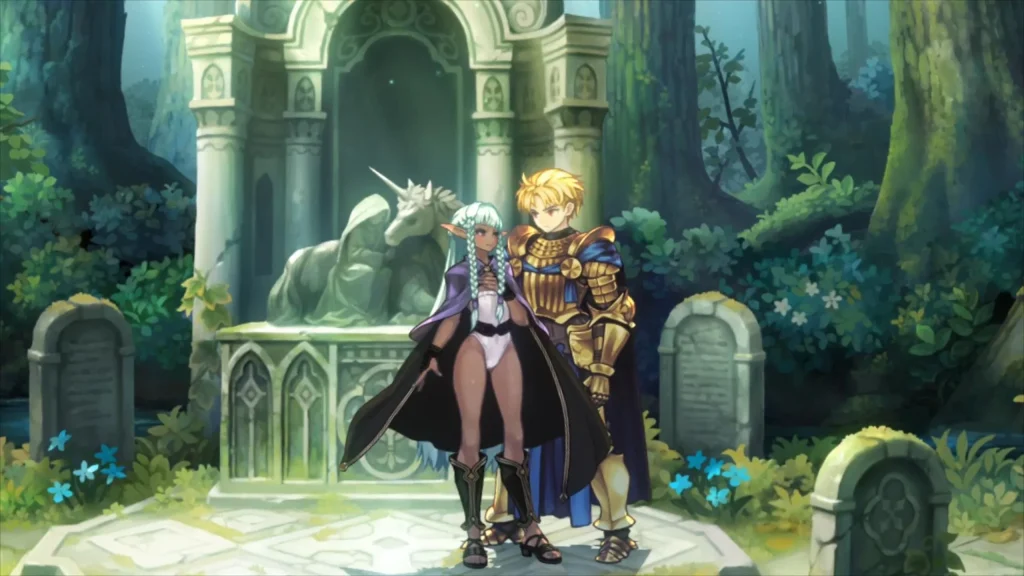
Beyond tactical programming, Unicorn Overlord hides a feature that players love to talk about: the Rite of Covenant — essentially, the marriage system.
Midway through the story, after reaching the elven kingdom of Elheim, Alain receives the Ring of the Maiden. Taking it to the altar on Palevia Island allows him to form a covenant with a character whose Rapport has been fully maxed out and whose personal dialogue scenes have all been viewed.
Two conditions must be met: the character’s Rapport with Alain must be at maximum, and you must have watched every one of their Rapport conversations. Rapport rises through fighting in the same unit, sharing meals at the inn, or giving gifts.
Several design choices make this system a hit: no gender restrictions on partners; the rite can be replayed after clearing the game; and the covenanted character gains a permanent +5 to all stats and +1 PP.
Art: Vanillaware’s strongest suit
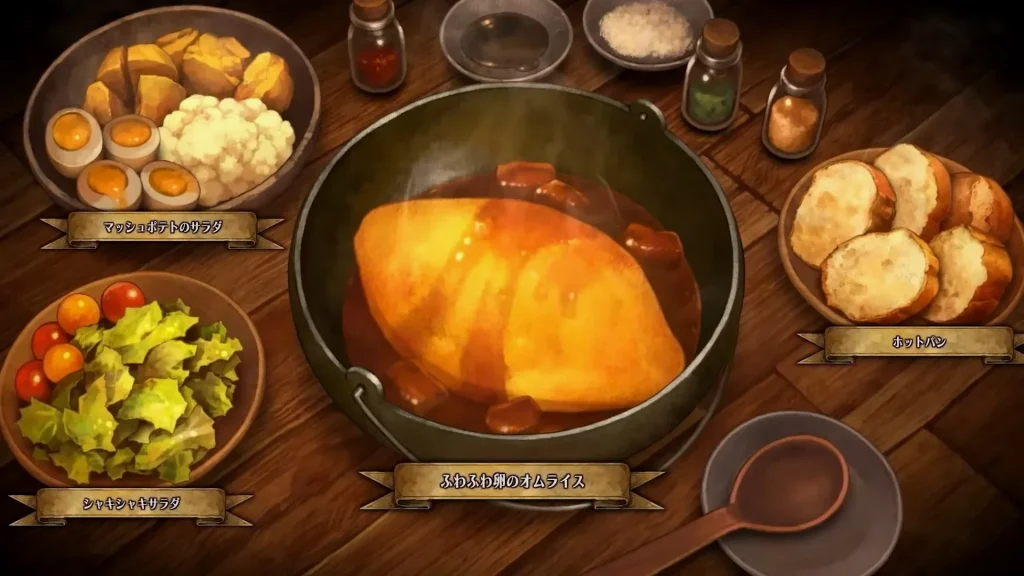
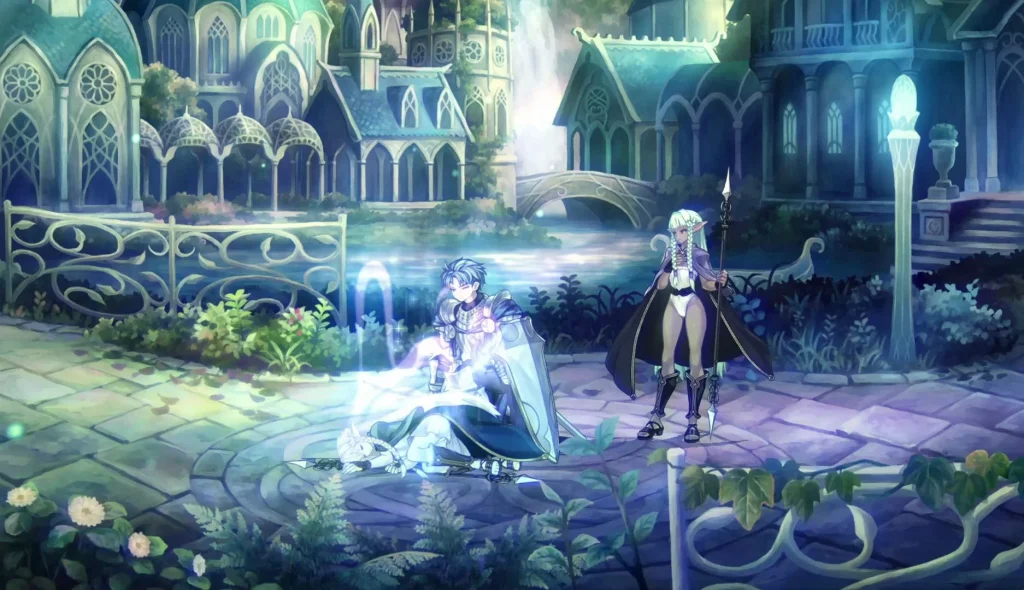
From Muramasa to Dragon’s Crown to 13 Sentinels, hand-drawn 2D art has always been the studio’s core strength. Unicorn Overlord continues that tradition, and pushes it even further. The food depictions are borderline obsessive — the team revealed in an interview that they originally planned to make the rations look unappetizing, like proper military fare. Everyone on the team disagreed, and the result is a full-on food gallery: perfectly seared steak, fluffy bread, beautifully plated desserts. Players joke that “this isn’t a tactics game, it’s a food simulator.”
In combat, all friendly units appear as blue silhouettes and all enemies as red, providing excellent visual clarity. The trade-off is that some character details visible in portraits — Scarlett’s red ribbon, for instance — get swallowed by the monochrome sprites.
Performance and optimization deserve praise too. The Switch version holds a near-stable 30 fps in both docked and handheld modes, with only a few minor dips during heavy effect sequences. The PS5 version offers higher resolution and hits 60 fps in many sections. Loading times are surprisingly comparable across platforms.
Development trivia: Director Takafumi Noma not only supervised; he also handled character design, programming, and scenario work, personally creating all 60-plus characters. Some enemies originally intended to stay as adversaries were gradually turned into recruitable companions during development. The game features over 100 distinct battle backgrounds.
Where it falls short
The biggest complaint is the sense of repetition in the latter half. Each nation’s liberation arc follows a similar template, and many of the 60-plus playable characters barely have personal storylines. As one player bluntly put it, “the content thins out the further you go, and most characters only matter during their recruitment scene and that region’s plot.”
That “two hours of programming, two minutes of fighting” dynamic is also divisive. When a perfectly optimized squad resolves a battle in ten seconds after hours of tinkering, some people love that very thing — the menu is the battlefield. For others, it always feels like there’s a pane of glass separating them from the action.
The relatively low amount of main-story text per character is another acknowledged weak point, though the bond conversations and special interactions between specific units still deliver plenty of appeal. It’s part of why some players who bounced off FFXII found Unicorn Overlord more enjoyable: the pacing is snappier, and it’s harder to get bogged down in grindy side content.
So, who is Unicorn Overlord for?
If you love tinkering with systems rather than simply stacking stats — adjusting skill conditions, arranging formations, building team synergies, and watching your custom logic play out perfectly — this game offers an enormously high tactical ceiling. If you played and enjoyed the Gambit system in Final Fantasy XII, this is made for you.
If Vanillaware’s art style resonates with you, especially if you come from the golden age of 90s Japanese SRPGs, you’ll likely fall for this. It draws from classics like Fire Emblem and Tactics Ogre, but uses hand-drawn 2D visuals to craft a flavor entirely its own.
If previous games have burned you out on endless live-service loops, Unicorn Overlord is different — it’s a complete standalone work that doesn’t depend on daily quests or version updates to stay relevant. You can pick it up anytime and play a session. Grab the Switch version for fragmented play sessions; go PS5 if raw visual quality matters more.
At a time when most games chase “bigger, fuller, never-ending,” Vanillaware’s decisive decision to stop might just be its most charming act of defiance.
All game screenshots, character designs, and related assets referenced in this article are the property of Vanillaware and Atlus. The article itself is an original work of commentary and curation. Please credit the source if reposting. For copyright concerns, contact [email protected].
Comments (9)