
Big Walk — When Communication Itself Becomes the Only Puzzle

On August 4, 2026, Big Walk officially launched.
Developed by House House—the studio behind Untitled Goose Game—and published by Panic, this co-op adventure carried considerable expectations before release. But Big Walk did something far riskier than “make another Goose”: it doesn’t clearly tell you what to do.
Six days later, sales surpassed 1 million copies. It quickly broke into the top ranks of Steam’s global sales charts, peaked at over 46,000 concurrent players, and reached a Metacritic score of 94 on PC at launch—making it one of the highest-rated games of 2026 at the time. IGN gave it a 9/10, calling it “a rewarding co-op adventure packed with delightful surprises.”
But what makes Big Walk truly special isn’t the scores. It’s the co-op design that almost no one else has attempted: if a game doesn’t tell you what to do, and won’t let you talk properly, what happens between you and your friends?
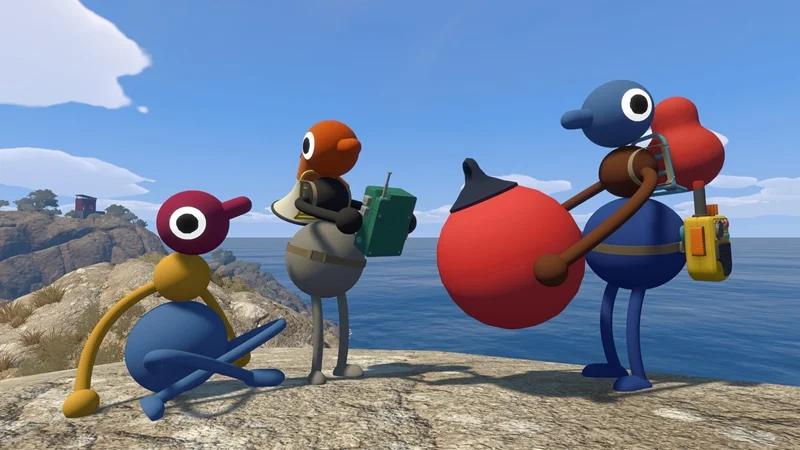
You’re a Creature Made of Three Stacked Balls, Dropped Into a Wilderness
Big Walk‘s character design continues House House’s signature absurdist aesthetic: you’re a being made of three stacked colorful spheres, with a pair of blank, wide eyes, stick-thin arms, and twig-like legs. When you talk, your nose flaps up and down like a mouth.
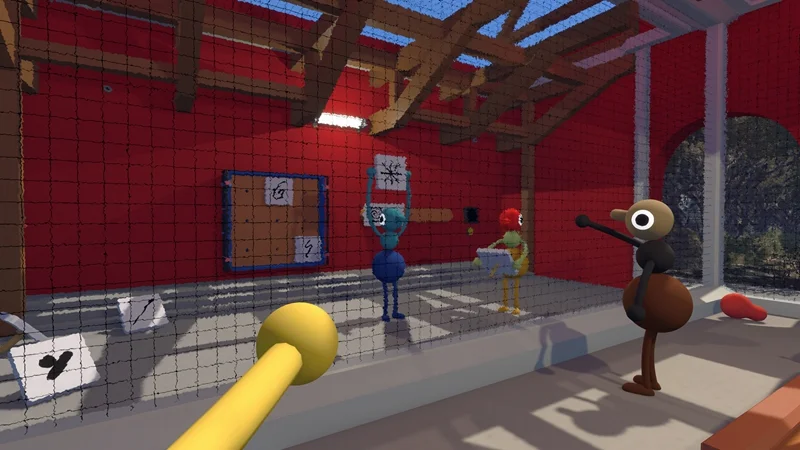
You’re placed in a brightly colored “playground”—a few climbable blocks, some flickable switches, and posters on the wall with instructions. The game barely tells you what to do next. You’re free, and you’re lost.
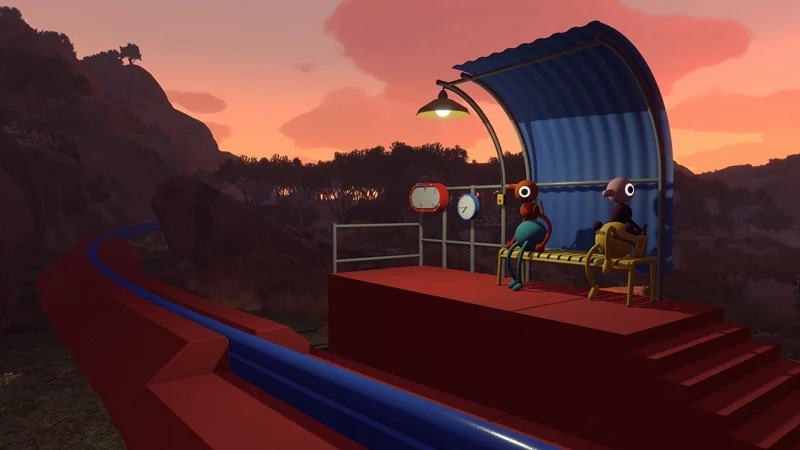
Step outside the playground, and you enter an expansive open world resembling the Australian outback: dense vegetation, waves lapping at sandy shores, and a mysterious giant sphere structure looming in the distance. You and your friends can “wander and get lost” together in this world.
That’s the entire starting point of Big Walk. No mini-map, no quest log, no objective markers.
Proximity Voice Chat: The Limitation, and the Entire Magic
If Big Walk were only “wandering around a big world,” it wouldn’t have hit a 94 Metacritic score at launch.
The real core is its proximity voice chat system.
The game’s primary communication method is distance-based voice chat. Stand behind a wall, and your voice becomes muffled. Enter a tunnel, and it echoes. If your teammate wanders too far, you can’t hear them at all. You can wave, type, or use a handful of tools to communicate—but none of them gives you effortless, always-on coordination.
Sounds like a technical limitation, right? But it’s the opposite—it’s one of Big Walk‘s core gameplay pillars. IGN’s review put it perfectly: “Big Walk is a puzzle game, and the puzzle is communication.”
The world is littered with objects that have no names. One reviewer called a red peanut-shaped object a “bean,” the building where you deliver beans the “bean tower,” the underground tunnels “the backrooms,” and the glowing orbs that light your path “light orbs”—as opposed to the mysterious “big light orb” in the distance. These things don’t always appear with clear, official names in the game. Players naturally give them nicknames, and those nicknames are understood only by you and your group.
The map design deliberately reinforces this process of “co-creating language.” You’ll find a button while exploring. You press it, nothing seems to happen—but a faint red light blinks in the distance. You send someone to check. They find a “bean” in a box. They grab it and run back, but nobody knows what it’s for—until someone drops it off a cliff.
Through these seemingly simple initial tasks, you and your teammates start to understand the world’s logic. You start creating your own language.
2 Players for Focus, 12 for Chaos
Big Walk is designed for at least 2 players in co-op, supporting up to 12 in cross-platform multiplayer. But the experience varies dramatically depending on group size.
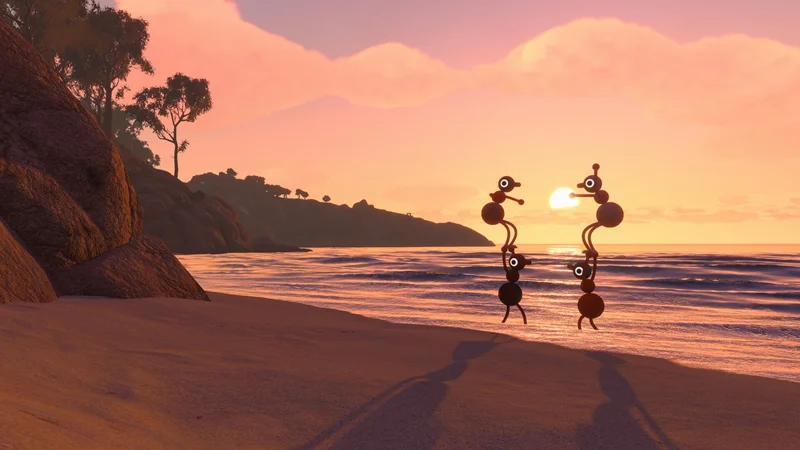
2-player mode is “focused co-op”—you and your partner must rely on good coordination and concise communication to solve puzzles. 12-player mode is “complete chaos”—a crowd in a massive world all talking over each other, with proximity chat’s distance limits making everything hilariously absurd.
The game adjusts parts of its world for three broad group sizes—2 players, 3 players, and 4 or more—so the puzzles and exploration still work as the group grows.
But it has no true single-player mode. You can start a game and explore a little on your own, but you’ll quickly hit limits you can’t push past. And there’s no public matchmaking—you basically need to have friends ready to play. This isn’t a “can be played solo but better with friends” situation. It’s designed around teamwork from the ground up.
Critical and Player Reception: 2026’s Indie Dark Horse
Big Walk‘s critical reception has been overwhelmingly positive.
- IGN: 9/10, “a rewarding co-op adventure packed with delightful surprises”
- Metacritic: PC version hit 94 at launch, becoming one of the highest-rated games of 2026 at the time
- OpenCritic: 89 at launch, 87% of critics recommending
- Steam: Over 34,000 user reviews, around 96% positive, with recent reviews at about 97%
One keyword that comes up again and again in player discussions is “playing with friends.” That mirrors the game’s own design: its puzzles, its communication limits, and its entire progression are built on cooperation. Some players describe it as “perfect for dragging your chaotic friends into a session,” while others note the game is “essentially a relaxed walking simulator, but it never actually feels that serious when you’re playing.”
Only One Hand: Turning “What to Carry” Into a Team Decision
Big Walk has another easily overlooked but deeply impactful design choice: before obtaining extra carrying equipment, each character can only hold one item at a time.
Map, flare gun, walkie-talkie, flashlight—you can only carry one. This means if you want to use the walkie-talkie for long-distance communication, you can’t also hold the map. If you’re carrying the flare gun to mark locations, you can’t use the flashlight to navigate in the dark.
This limitation forces players to constantly swap items and forces the team to divide roles. Someone handles the map, someone carries the walkie-talkie, someone provides light. Every choice of what to carry is, in practice, a team division of labor.
And the game’s name fits perfectly: you really do walk a lot. Back and forth between towers and puzzle points, running back to the start because someone forgot an item. This “inconvenience” is deliberate—it gives every movement weight.
The Real Barrier: You Need a Group of People Willing to Get Lost
If you have a group of friends willing to let go of “efficiency thinking” and accept that getting lost is part of the game—it might be one of the most unique co-op games you’ll encounter this year. The fun isn’t in beating it; it’s in the moments you and your friends create while wandering, the ones only you understand.
If you’re used to efficiently clearing quests solo and speedrunning with guides—Big Walk will clash directly with your gaming habits. No objectives, no guidance, no single-player mode. For some players, these designs mean “freedom.” For others, they mean “aimlessness.”
If you’re looking for a co-op game you can replay long-term—know that Big Walk‘s freshness comes largely from first discovery and first language creation. After you finish, you and your friends already have your own language. Walking into the same world a second time will feel different.
Big Walk is priced at $19.99 on Steam; the PS5 version was offered as a PS Plus monthly game in August 2026. For a co-op adventure that typically takes around 10 hours—though actual time depends on how much you explore—the price itself isn’t the barrier. The real barrier is: do you have those few people willing to get lost with you?
Copyright Notice: All game screenshots, character images, and related assets used in this article are the property of House House and Panic and their respective rights holders. This article is intended solely for game introduction, review, and informational purposes.
Comments (0)
No comments yet