
ForgeTax — When Greed Becomes the Core Game Mechanic

In late September 2026, a game called ForgeTax launched on Steam. Its developer, GraveYardDev, was relatively unknown before the game’s release. Its system requirements are modest: the minimum GPU is a GTX 960 or Radeon RX 560, so some older PCs should be able to run it. But the Steam page captures the game’s core in a single line: “One swing, and your sword’s worth skyrockets. Another swing, and maybe it’s scrap.”
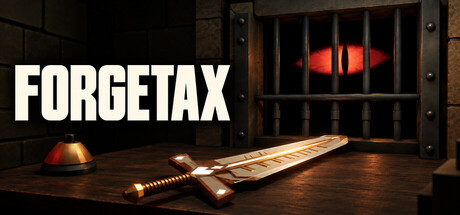
That’s not just marketing copy. It’s the design manifesto.
You’re Not Forging Swords — You’re Gambling
ForgeTax‘s gameplay boils down to one loop: pick up an old sword from the ground, heat it in the furnace, place it on the anvil, and swing your hammer. Every strike has a chance to raise the sword’s value — and a chance to shatter it entirely. The higher the value, the greater the risk. You have to choose between “one more swing” and “cash out now.”
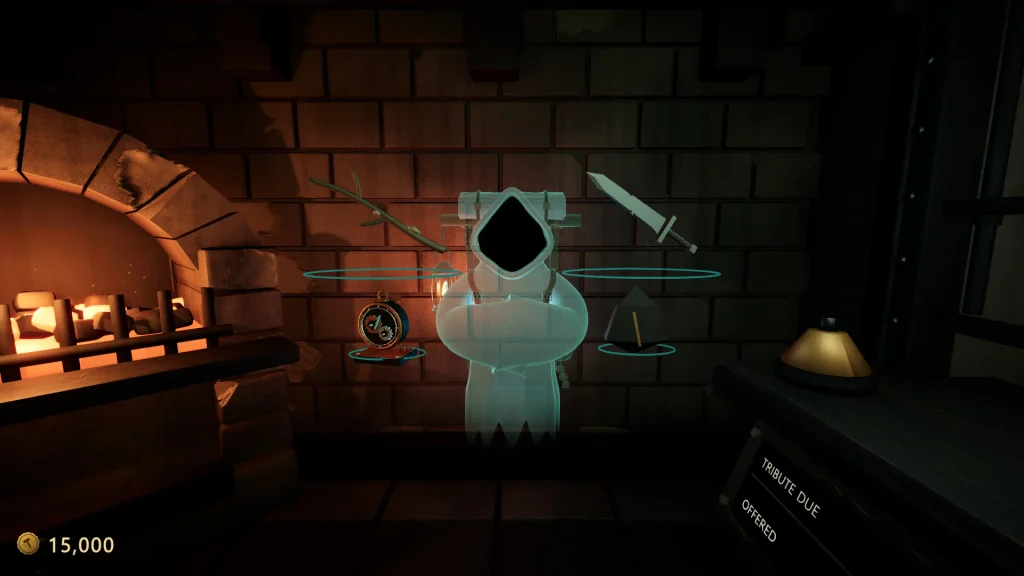
That choice works because the game turns every hammer strike into a draw from a pool of tickets. The forging system uses a lottery-style draw with five possible outcomes: Break, Damage, Hold, Success, and Great Success. Each strike draws one ticket from a pool of 1,000. Success raises the sword by one level, Great Success by two, Hold changes nothing, Damage drops it by one, and Break destroys the sword outright.
This means you never know what the next strike will bring. You might be holding a sword worth a fortune, swing once more, and watch it shatter into nothing. Or a seemingly ordinary sword might score several Great Successes in a row and become an absurdly valuable masterpiece far beyond what the tribute requires. That tension — “I don’t know what the next swing will do” — is the game’s core source of fun.
From a behavioral design standpoint, this random-reward mechanic shares psychological DNA with gambling. The player doesn’t know whether the next strike brings profit or loss, which makes the urge to “try just one more” almost irresistible.
Relics: Turning Gambling Into Buildcrafting
If ForgeTax were only “swing hammer, pray to RNG,” it wouldn’t keep players engaged for long. What gives it roguelite depth is the relic system.
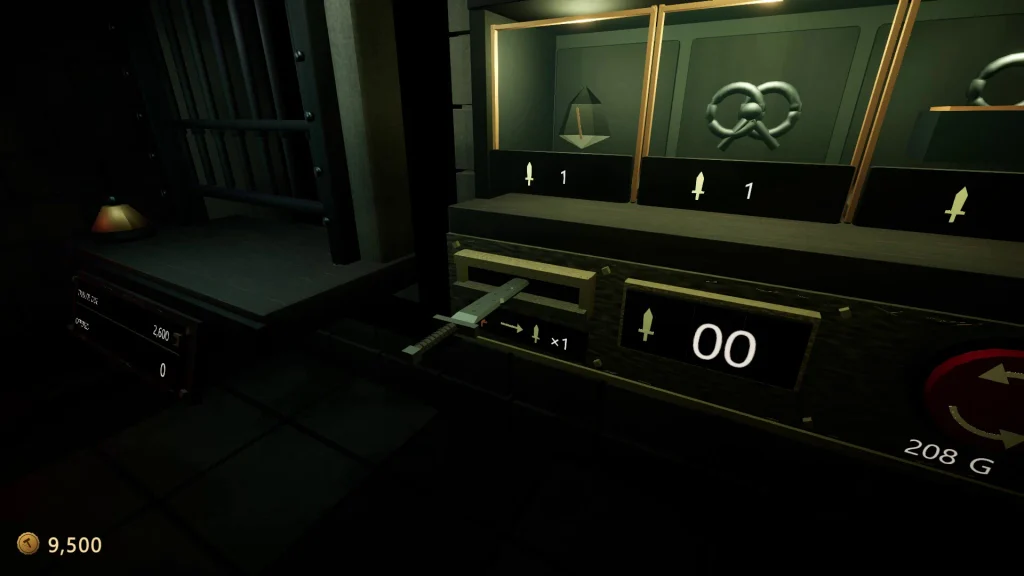
Relics are acquired in a unique way: the relic vending machine doesn’t take money — it takes swords. Every sword spent on a relic is one less sword available for the dragon’s tribute. This creates a brutal resource trade-off: relics can improve your forging efficiency and survivability, but every blade spent on a relic is one less blade you can offer as tribute.
As for what relics actually do — many directly alter the distribution of random outcomes, while others build new synergies around Damage, Break, and upgrade returns. Together, they change how the player absorbs risk. “Cracked Splice,” for example, reduces the sword’s Break chance by 15% for each Damage, stacking up to 60%. “Giant’s Spine” stores a protection charge for every two Damage results, converting the next Break into Damage instead — though the protection charge itself does not count as a Damage. Other relics shift the ticket pool to make Success and Great Success more frequent, or build around a Damage-focused strategy — turning “getting hurt” itself into a tactic.
This transforms the game from pure luck-based gambling into probability management. You still can’t control any individual strike, but you can reshape the entire ticket pool through relic combinations. Build a strategy that follows your luck, or make luck serve your strategy — that’s the strategic space the game offers.
“Frenzy”: A Safety Valve for Greed
The game has a mechanic called “Frenzy.” By default, after forging the same sword 10 times, the next strike triggers Frenzy. It lasts 4 seconds, during which the sword cannot break. You can swing freely and push the value to heights you’d never dare attempt otherwise.
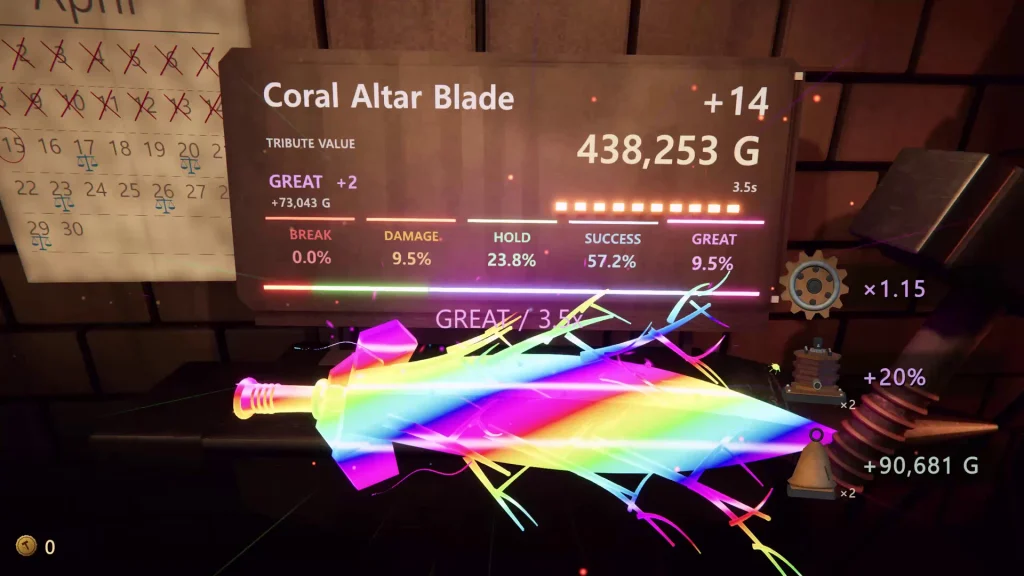
But that doesn’t mean every strike during Frenzy raises the value. Damage and Hold results can still appear — only Break is removed. One player noted that during Frenzy, “if you’re fast, you can get seven or eight swings in,” but the duration is “really short” — slow hands lose out. Relics can also modify Frenzy duration, so 4 seconds isn’t fixed across all builds.
This makes Frenzy itself a test. It gives you a safety window, but the size of that window depends on your reaction speed and build choices. A brief safe period actually creates a new kind of tension.
Survival Pressure: 21 Days and an Impatient Dragon
The setup is simple: you’re imprisoned by a dragon and must pay a daily tribute over 21 days that increases every day. Fail to meet the tribute, and the dragon loses patience; accumulate three tribute failures, and you die. Survive all 21 days without hitting the failure limit, and you earn your freedom. The tribute starts at 1,800G on Day 1, rises to 7,500G by Day 7, 45,800G by Day 14, and reaches a base requirement of 232,000G by Day 21.
This framework gives every forging session immediate survival weight. What you shatter isn’t just a sword — it’s your chance to live another day. When the tribute climbs from a few thousand to tens of thousands and eventually past two hundred thousand, the cost of breaking a high-value sword isn’t just “what a waste” — it’s “I might die today.”
Some players report making repeated attempts without getting past Day 14. Once the mid-game hits, tribute demands spike quickly, and losing a single high-value sword can wipe out everything you’d built up.
The Problem: Nowhere to Release Your Power
ForgeTax attracted a fair number of players after launch, but that attention didn’t translate into consistent praise. As of October 10, 2026, ForgeTax had around 410 Steam user reviews, with roughly 47% rated positive, leaving it with an overall “Mixed” rating. That tells you the core concept has pull, but the actual experience hasn’t won over most players.
Existing feedback points to two notable issues.
The first is repetition. One player wrote in a Steam community review: “Forging becomes repetitive. Every time you go through the same tedious first phase.” (translated) This is a common challenge for all “action-driven roguelites”: the simpler the core action, the faster repetition sets in. The hammer strike itself never changes — what changes are the odds and relic synergies behind it, but physically, the player is doing the same motion every time.
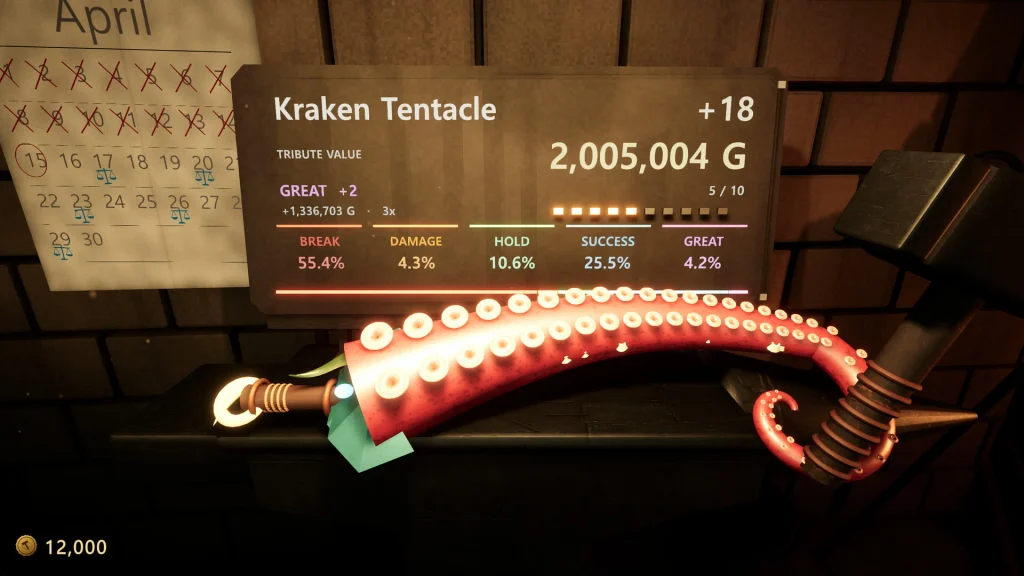
The second issue is more specific: the weapons you forge may be far stronger than the main story requires, but there’s nowhere to use them. One player noted: “You can forge weapons far more powerful than the main campaign needs, but there’s nowhere to use that extra power. It makes most of the value you create feel wasted.” (translated)
The game does let you continue forging after completing the 21-day contract, and tribute demands keep rising. But there’s currently no combat mode that gives those powerful builds a meaningful outlet. Higher tribute requirements alone don’t make for a rich endgame.
The developer has announced plans to let players fight the dragon using their own forged swords. If that update materializes, it could address the current endgame gap. For now, however, that content remains unimplemented.
This may be a scope limitation at launch, but whatever the reason, the lack of a meaningful outlet for powerful builds limits the game’s long-term appeal.
What It Gets Right
What’s most commendable about ForgeTax is that it takes an extremely simple action — swinging a hammer — and turns it into a complete risk-management system.
Relics turn luck into buildcrafting. Frenzy turns greed into strategy. The 21-day deadline turns every strike into a survival bet. Stack these three systems together, and “one more swing” always carries weight. You know a break could mean losing it all, but you also know stopping short might leave you unable to pay tribute. That dilemma isn’t just numerical pressure — it comes from the interlocking of several mechanics.
It’s small in scope, and its current long-term goals and endgame content are still limited. But within what exists, it delivers one core experience with remarkable clarity: letting you feel the weight of greed firsthand.
If you enjoy high-stakes decision-making and roguelites where relic combinations reshape how you play, ForgeTax is worth considering even with its limited endgame. But if you care more about rich late-game challenges, you might want to wait for more concrete news about the planned dragon-combat update.
Copyright Notice: All game screenshots, character images, and related assets referenced in this article are the property of their respective rights holders, including GraveYardDev. This article is intended for game coverage, commentary, and informational purposes only.
Comments (0)
No comments yet