
Happy Wheels — When a Physics Engine Learns to Joke, All You Can Do Is Scream and Laugh

If you went to middle school in the 2010s, you probably saw this scene at least once: in the computer lab, one second everyone is pretending to work on a spreadsheet, the next second a dull thud comes from the corner, followed by barely suppressed laughter from nearby classmates. On screen, a guy in a wheelchair has just been impaled by spikes, his body and chair flying to opposite ends of the screen. That’s Happy Wheels — a game that makes you happy by making you crash.

On September 21, 2026, this 16-year-old Flash classic finally launched on Steam as a standalone release. Before launch, its wishlist count broke 750,000. As of this writing, English-language player reviews on Steam have surpassed 2,700, with 95% positive and an “Overwhelmingly Positive” rating. Even developer Jim Bonacci himself didn’t expect this many people to be waiting. He wrote in a Steam announcement that he sat in terror looking at the 750,000 wishlist number, having realistically thought it might be 5,000 at best.
You’re Not Trying to Beat the Level — You’re Trying to Crash
The gameplay of Happy Wheels can be summed up in one sentence: pick a loser, get on his vehicle, and race toward the finish line on a track full of deadly traps. But if you think this is a racing game, you’ve already missed the point.
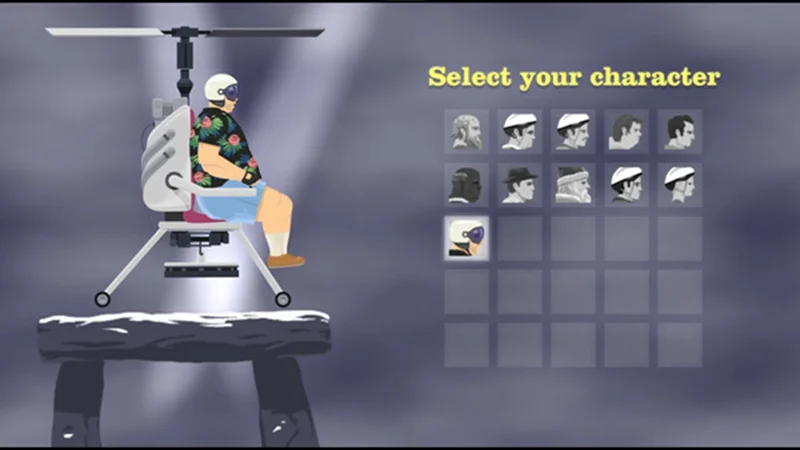
The real appeal of this game has never been about “reaching the finish line” — it’s about “how you die.” The wheelchair guy rolling three and a half times on spikes, the dad on a bicycle using his son as a human airbag against a landmine, the Segway office worker getting sliced in half by a falling hammer — every frame shows off the absurd charm of a ragdoll physics engine. Even if a character is missing half his body, as long as the wheels are still turning, he can keep crawling forward. This “beauty of incompleteness” is Happy Wheels’ signature punchline and its irreplaceable soul.

Its dark humor isn’t built from dialogue — it’s calculated by the physics engine. Every collision triggers a chain reaction you can’t predict, so the same trap can send you into a completely different crash scene. You won’t grow numb from seeing too much. Instead, you’ll open each attempt like a blind box, eager to see what pose you’ll fly out in this time.
What Keeps It Alive to This Day Is the Editor
If Happy Wheels only had official levels, it probably wouldn’t have lasted three years. What kept it alive and on Steam’s front page 16 years later is its level editor.
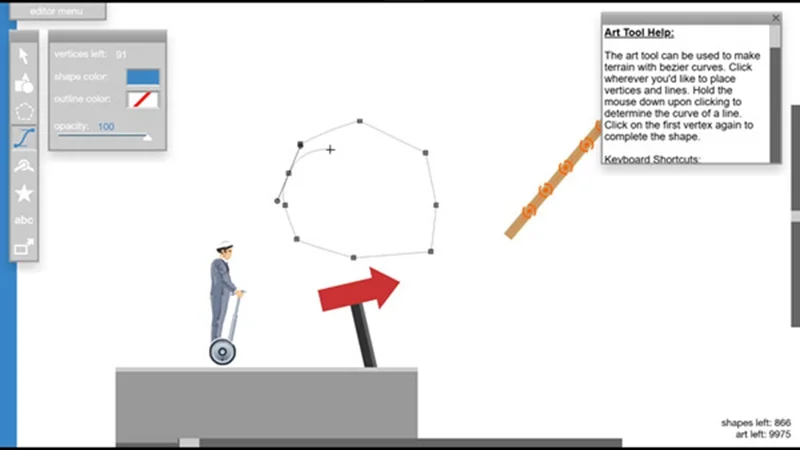
The Steam version opens up over 5 million player-made levels for free exploration. Five million. That number means even if you played 100 levels a day, it would take you over 130 years to finish them all.
The quality of these player-made levels varies wildly — there are carefully designed puzzle tracks, and there are pure “author malice” hellscapes. But it’s precisely this unpredictability that gives the game almost infinite replayability. You never know if the next level will make you gasp in admiration or make you want to smash your keyboard. And the Steam version adds daily player levels, offline downloads, Steam achievements, and controller support, making this community ecosystem even more complete.
In this sense, Happy Wheels is actually a creation platform disguised as a level-based game. It provides a simple, intuitive set of tools so every player can become a level designer with a mean streak, building their happiness on other people’s crashes.
Why It “Came Back to Life”
Why did a 16-year-old Flash game launching on Steam cause such a stir?

The answer is simple: it represents an era. The Flash game era is over, but the memories of sneaking in Happy Wheels during computer lab haven’t disappeared. When Happy Wheels returned as an official version for $5, with no ads and controller support, many people weren’t buying a game — they were buying a return ticket.
And players who’ve never touched it are drawn by something else: in an age where games are increasingly polished and increasingly “correct,” Happy Wheels offers a pure, crude kind of joy. You don’t need to understand a story, study a build, or read a tutorial. You just pick a character, step on the gas, and watch the physics engine break you.
Sixteen years ago, Jim Bonacci probably never imagined that a “crash simulator” built on ragdoll physics would earn an “Overwhelmingly Positive” rating on Steam in 2026. But some things just work out that way: when you put the word “happy” in the title and then make players laugh out loud amid blood and flying limbs, you’ve already done something right.
Copyright Notice: All game screenshots, character images, and related assets referenced in this article are the property of their respective rights holders, including Jim Bonacci and Fancy Force. This article is intended for game introduction, review, and informational purposes only.
Comments (0)
No comments yet