
Ananta Review – The Real Question Isn’t Whether It’s a “Mashup,” but Whether This City Can Breathe

Release Date: January 15, 2027 | Developer: NetEase Thunderfire – Naked Rain Studio | Platforms: PS5, PC, iOS, Android | Genre: Urban Open-World RPG | Business Model: Free-to-play + cosmetic purchases | Languages: Simplified Chinese, Traditional Chinese, Japanese, English, and more
The game was first revealed in August 2023, and its first playable demo debuted at Tokyo Game Show 2025, where lines reportedly stretched to three hours. At Gamescom 2026’s Opening Night Live, it finally locked in a release date: January 15, 2027. From first reveal to that announcement: 1,097 days.

Ananta carries a long list of descriptors: a development team numbering in the hundreds, an urban open world, anime aesthetics, no character gacha, DLSS 4 + ray tracing. It’s trying to do so much that many people’s first reaction is simply: “mashup.”
But “mashup” isn’t the real issue. The question is: does it do it well? And more importantly — once all those parts are assembled, can the city actually feel alive?
A City That Breathes
Ananta‘s core selling point isn’t combat. It isn’t story. It’s the city itself.

The game has already revealed several major urban areas, including Xinqi, Chongxiao, and Lingyun. Among them, Chongxiao draws inspiration from Hangzhou and Shanghai, blending the Oriental Pearl Tower, the Bund, and Wukang Road with West Lake, Leifeng Pagoda, and Longjing Village.

What makes the city feel alive, though, isn’t the landmarks — it’s the NPC behavior. NPCs dressed in streetwear will dance with you. Student-looking NPCs will high-five you. If you approach thugs while playing as a police officer, they’ll become alert and try to run. You can even pull a chair out from under an NPC as they’re about to sit down.
The development team describes them as small, “useless” interactions that give the city a sense of warmth and everyday life.
You can go clubbing at a music venue, browse an art gallery, or just sit at a café and do nothing. You can glide, skateboard, drive flying cars, pilot boats and helicopters, or even ride shared bikes and scooters. There are arcades, cat cafés, and fashion stores.

Some outlets have called it “a Yakuza-style brawler wrapped in an anime GTA.” Others see traces of Spider-Man‘s swinging, Watch Dogs‘ hacking, and Sleeping Dogs‘ hand-to-hand combat.
And here’s the catch: the more stuff you pack in, the easier it becomes to look like “something else.”
Kung Fu Movie-Style Combat
The combat system emphasizes environmental interaction and improvisation.

You can string together unarmed combos, or pick up nearby objects — trash cans, tennis rackets, hammers, construction barriers — each with its own unique animation set. Enemies can be slammed into dumpsters or kicked into cars.

Ranged options include machine guns and rocket launchers. Combat mechanics include perfect parries, parry counters, and environmental interactions. Blue attack indicators are parryable or counterable; red ones require dodging. A full energy bar unlocks finishing moves.
Early previews have praised the melee combat as “excellent,” with one outlet describing it as “a Jackie Chan movie in game form — full of variety.”

Gunplay has drawn more mixed reactions — “average” at best, and not yet on GTA‘s level. Right now, melee is the clear strength; shooting, the clear weak point.
Character switching also stands out — not as a traditional party swap, but as independent characters roaming the city. When you switch, the camera lifts to a top-down view of the entire city, then zooms in on another character in a completely different district. That switch drops you directly into their daily routines: a courier making deliveries, a cop on patrol.
Gacha-Free
The most disruptive thing about Ananta: no character gacha.
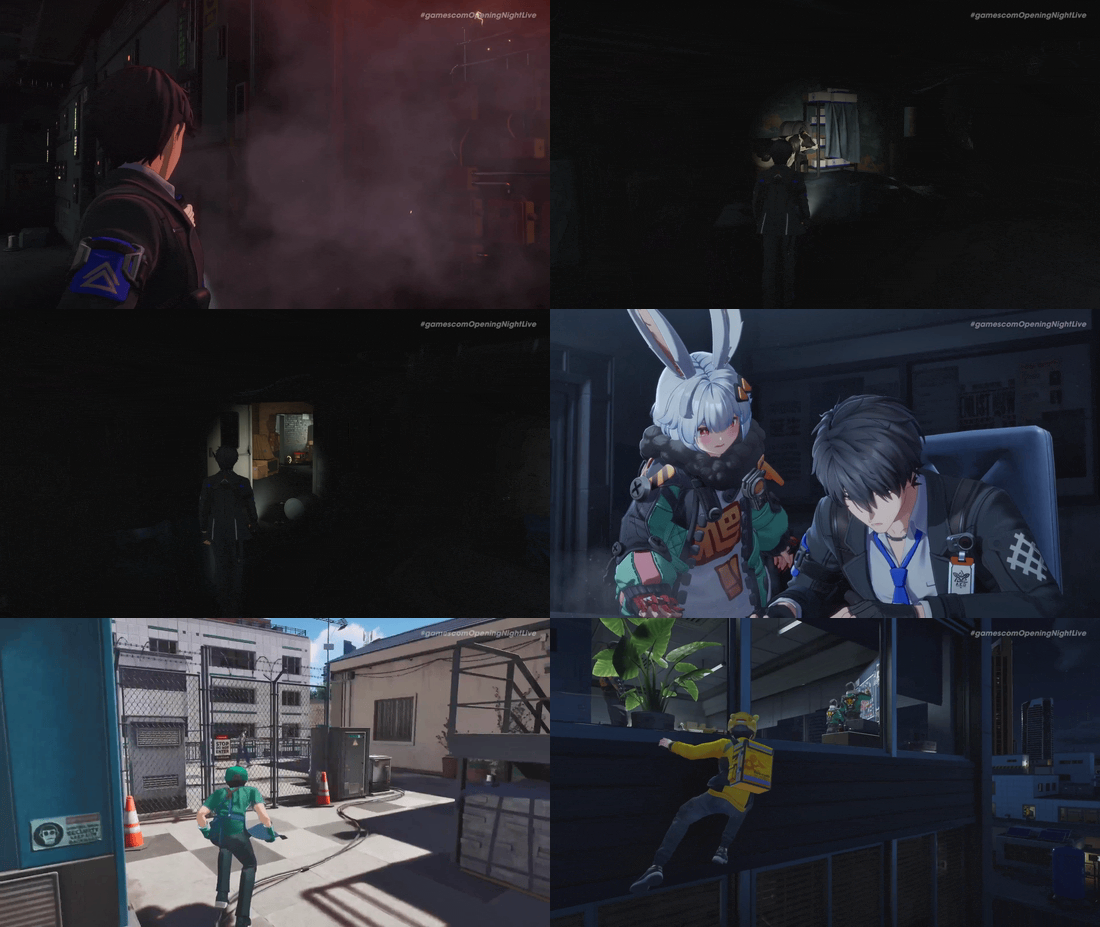
All playable characters can be unlocked through gameplay. No character banners, no random pulls. The developers’ reasoning: “We want players to freely choose characters and experience a diverse range of lives without barriers.”
Based on what’s been publicly confirmed so far, monetization centers on cosmetics — character skins, vehicle paints, furniture and decor — rather than anything that affects combat stats or progression.
The risk is clear: revenue becomes heavily reliant on cosmetic content. That puts considerable pressure on ongoing art production and content quality. If skins lose their appeal over time, players have less reason to keep paying. Whether NetEase can resist introducing hidden stat-based monetization later is something everyone’s watching.
The City Isn’t Finished Yet
Driving needs work. Preview reports noted that it “wasn’t enjoyable — the vehicle speed felt too slow.” For now, the driving system remains one of the game’s most obvious rough edges.
Gunplay isn’t up to the melee standard yet. The better the hand-to-hand combat is, the more noticeable the shooting’s shortcomings become.
The “mashup” perception remains a challenge. You can see traces of GTA, Watch Dogs, Spider-Man, and Sleeping Dogs. Blending influences isn’t the problem — but there’s a gap between “recognizable influences” and “having its own identity.”
And the long-term challenge is the business model. A cosmetic-driven monetization model puts constant pressure on art quality. Any prolonged drop in content quality could hurt player spending.
The Real Question: Can It Become Ananta?
What makes Ananta risky is exactly what makes it compelling.
The city scale of GTA. The swinging of Spider-Man. The brawling of Yakuza. The hacking of Watch Dogs. Wrapped in anime aesthetics and a Chinese urban backdrop. It has taken some of the most successful pieces of the last decade and tried to combine them all.
So the “mashup” label isn’t really the issue.
The real issue is: after dozens of hours, can players see these systems as Ananta — or will they still see them as echoes of other games?
At the very least, it has already shown one thing: NetEase isn’t just building a pretty open-world map. It’s trying to turn movement, combat, professions, and daily life into things you can actively play.
On January 15, 2027, the question it ultimately answers won’t be “Does it look like GTA?” It will be: “Does it deserve to be called Ananta?”
Copyright Notice: All game screenshots, character images, and related materials referenced in this article are the property of NetEase and Naked Rain Studio, and are used for game introduction, review, and informational display purposes.
Comments (0)
No comments yet